History of AI
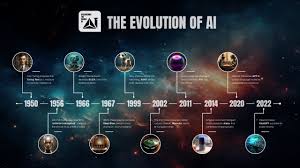
The history of artificial intelligence (AI) began in antiquity, with myths, stories, and rumors of artificial beings endowed with intelligence or consciousness by master craftsmen. The study of logic and formal reasoning from antiquity to the present led directly to the invention of the programmable digital computer in the 1940s, a machine based on abstract mathematical reasoning. This device and the ideas behind it inspired scientists to begin discussing the possibility of building an electronic brain.
The field of AI research was founded at a workshop held on the campus of Dartmouth College in 1956.[1] Attendees of the workshop became the leaders of AI research for decades. Many of them predicted that machines as intelligent as humans would exist within a generation. The U.S. government provided millions of dollars with the hope of making this vision come true.[2]
Eventually, it became obvious that researchers had grossly underestimated the difficulty of this feat.[3] In 1974, criticism from James Lighthill and pressure from the U.S.A. Congress led the U.S. and British Governments to stop funding undirected research into artificial intelligence. Seven years later, a visionary initiative by the Japanese Government and the success of expert systems reinvigorated investment in AI, and by the late 1980s, the industry had grown into a billion-dollar enterprise. However, investors' enthusiasm waned in the 1990s, and the field was criticized in the press and avoided by industry (a period known as an "AI winter"). Nevertheless, research and funding continued to grow under other names.
In the early 2000s, machine learning was applied to a wide range of problems in academia and industry. The success was due to the availability of powerful computer hardware, the collection of immense data sets, and the application of solid mathematical methods. Soon after, deep learning proved to be a breakthrough technology, eclipsing all other methods. The transformer architecture debuted in 2017 and was used to produce impressive generative AI applications, amongst other use cases.
Investment in AI boomed in the 2020s. The recent AI boom, initiated by the development of transformer architecture, led to the rapid scaling and public releases of large language models (LLMs) like ChatGPT. These models exhibit human-like traits of knowledge, attention, and creativity, and have been integrated into various sectors, fueling exponential investment in AI. However, concerns about the potential risks and ethical implications of advanced AI have also emerged, causing debate about the future of AI and its impact on society.
Power of AI
Artificial Intelligence (AI) possesses significant power to transform various aspects of life and work. Its key strengths lie in its ability to automate tasks, analyze data, personalize experiences, and drive innovation across industries. AI's capacity to learn, adapt, and make predictions based on vast datasets has made it a crucial tool for tackling complex challenges and improving efficiency in numerous fields.
Here's a breakdown of AI's power: 1. Efficiency and Automation: AI excels at automating repetitive and time-consuming tasks, freeing up human workers for more strategic and creative endeavors. This includes automating data collection, processing, and analysis, as well as physical tasks in manufacturing and logistics.
2. Enhanced Decision-Making: AI algorithms can analyze large datasets and identify patterns that humans might miss, providing valuable insights for informed decision-making in various fields, from business to healthcare. 3. Personalization: AI enables personalized experiences by understanding individual preferences and tailoring recommendations, content, and services accordingly. This is evident in areas like personalized medicine and targeted advertising.
4. Innovation and Scientific Advancements: AI is accelerating research and development in various fields, including drug discovery, materials science, and climate change mitigation, by enabling faster simulations, data analysis, and
5. Addressing Global Challenges: AI is being utilized to address critical global issues such as climate change, disease outbreaks, and disaster response, by optimizing resource allocation, predicting potential threats, and developing sustainable solutions.
6. Transforming Industries: AI is revolutionizing numerous industries, including healthcare, finance, transportation, and entertainment, by improving efficiency, creating new products and services, and enhancing customer experiences.
Benifits of using AI
Automation of Tasks – AI can handle repetitive and time-consuming tasks quickly and accurately, freeing humans for creative and strategic work.
Improved Decision Making – AI analyzes large amounts of data to provide insights and predictions, helping in better and faster decisions.
24/7 Availability – Unlike humans, AI systems can work continuously without breaks, increasing productivity.
Cost Savings – Automation reduces labor costs and minimizes errors, saving time and money.
Personalization – AI powers recommendations (like in Netflix, YouTube, or e-commerce) tailored to user preferences.
Enhanced Accuracy – AI systems can achieve high precision in fields like medical diagnosis, fraud detection, and quality control.
Innovation Opportunities – AI enables new products, services, and solutions that were not possible before.

Job Loss & Economic Disruption – Automation can replace human roles, leading to unemployment in certain industries.
Bias & Discrimination – If AI is trained on biased data, it can make unfair decisions in hiring, lending, policing, etc.
brPrivacy Violations – AI can collect, track, and analyze personal data in ways that invade privacy.
Misinformation & Deepfakes – AI can generate fake news, audio, or videos that mislead people.
Loss of Human Control – If AI systems make important decisions without transparency, it can be dangerous in areas like healthcare, finance, or defense.
Security Threats – AI can be used for cyberattacks, hacking, or autonomous weapons.
💬 Chat & Content Creation
ChatGPT – Conversational AI for writing, coding, and
Claude – AI assistant by Anthropic, strong in reasoning and Gemini – Google’s AI for search, content, and productivity.
🎨 Image & Design Midjourney – Generates high-quality, artistic images. DALL·E 3 – Creates realistic or creative images from text prompts. Canva Magic Studio – AI-powered design and editing tools.
🎥 Video & Audio Pika Labs – AI video generation from text or images. Runway – Video editing, motion tracking, and text-to-video tools. ElevenLabs – High-quality AI voice generation.
📊 Data & Productivity Microsoft Copilot – AI integrated into Office apps. Notion AI – Helps with notes, summaries, and content in Notion. Tableau GPT – AI insights for data visualization.
💻 Coding & Development GitHub Copilot – Code suggestions in real time. Replit Ghostwriter – AI coding assistant for building apps quickly. Tabnine – AI code completion for multiple languages.
Back to Top